This comprehensive guide covers 400+ words organized by length, helping Indian learners master vocabulary efficiently and boost their language skills for academic and professional success.
2 Letter Words that End in T
| Word | Word | Word | Word | Word |
|---|---|---|---|---|
| at | it | ut | et | ot |
| Word | Word | Word | Word | Word |
| at | it | ut | et | ot |
Two-letter words ending in T are fundamental building blocks for word games and basic communication. These include “at” (location preposition), “it” (pronoun), and “ut” (musical note). Though limited in number, they appear frequently in everyday English and serve as essential components in crossword puzzles and Scrabble matches. Mastering these short words helps beginners build confidence in English vocabulary and understanding sentence structure.
More Posts: 400+ Words Ending With C-English Learning
3 Letter Words that End in T
| Word | Word | Word | Word | Word | Word | Word | Word |
|---|---|---|---|---|---|---|---|
| act | ant | art | bat | bet | bit | bot | but |
| cat | cot | cut | dot | eat | fat | fit | get |
| gut | hat | hit | hot | hut | jet | jot | kit |
| let | lit | lot | mat | met | net | not | nut |
| oat | out | pat | pet | pit | pot | put | rat |
Three-letter T-ending words form the foundation of English vocabulary, commonly used in daily conversations and academic writing. Words like “act” (perform), “ant” (insect), and “art” (creative expression) are crucial for elementary education and ESL learners. These terms appear frequently in competitive exams, spelling tests, and word puzzles, making them essential for Indian students preparing for school assessments and entrance tests.
More Posts: 400+ Words Ending With U-English Learning
4 Letter Words that End in T
| Word | Word | Word | Word | Word | Word | Word | Word |
|---|---|---|---|---|---|---|---|
| beat | bent | best | belt | boat | boot | cast | cart |
| chat | cost | debt | diet | dust | exit | fact | fast |
| feet | felt | fest | flat | font | foot | fort | gift |
| goat | gust | halt | heat | hunt | hurt | jest | just |
| kept | knot | last | left | lift | list | lost | mast |
Four-letter words ending in T bridge basic and intermediate vocabulary levels, essential for standard competitive exams and business communication. Terms like “best” (highest quality), “fact” (truth), and “gift” (present) are indispensable in professional emails, academic papers, and everyday interactions. These words enhance writing clarity and help students score better in English proficiency tests conducted across Indian educational institutions.
More Posts: 400+ Words Ending with D-English Learning
5 Letter Words that End in T
| Word | Word | Word | Word | Word | Word | Word | Word |
|---|---|---|---|---|---|---|---|
| about | admit | adult | alert | beast | blast | boost | breast |
| built | burst | cadet | chest | coast | count | court | craft |
| crest | drift | dwelt | elect | event | exact | exist | feast |
| fight | fleet | float | frost | fruit | ghost | giant | grant |
| guest | guilt | habit | heart | input | joint | light | might |
Five-letter T-ending words represent intermediate vocabulary crucial for board exams, IELTS preparation, and professional writing. Words such as “admit” (acknowledge), “event” (occasion), and “heart” (organ/emotion) appear frequently in literature, news articles, and formal documentation. Indian students benefit from mastering these terms for essay writing, comprehension passages, and verbal reasoning sections in entrance examinations like CAT, GMAT, and GRE.
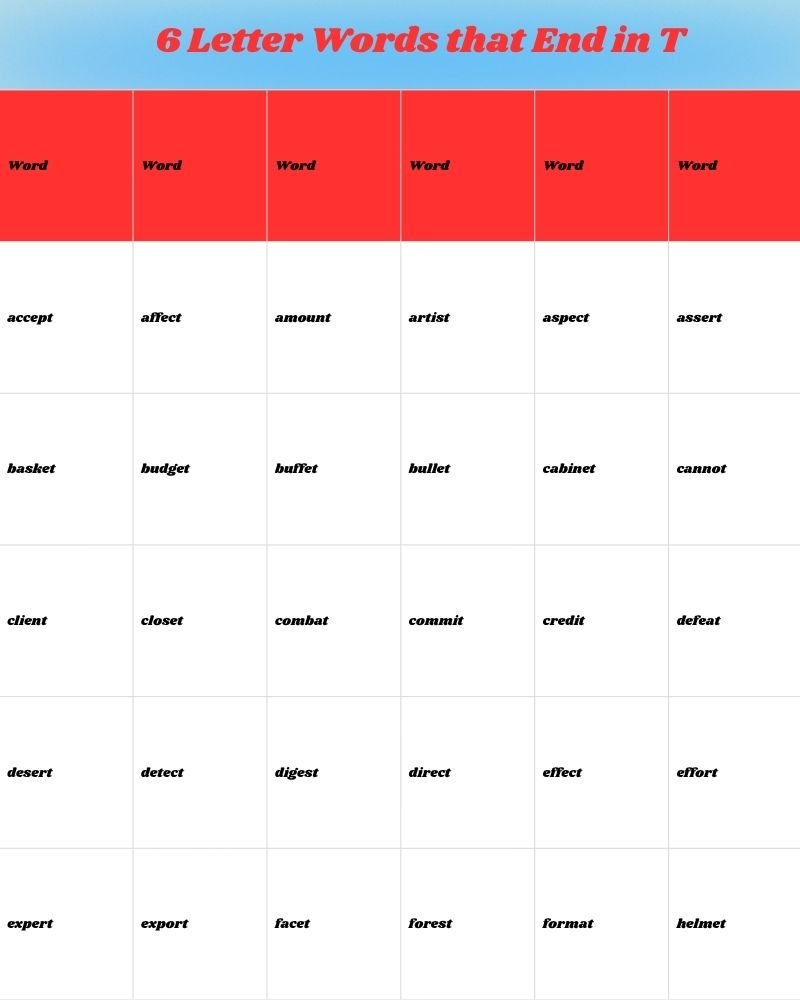
6 Letter Words that End in T
| Word | Word | Word | Word | Word | Word | Word | Word |
|---|---|---|---|---|---|---|---|
| accent | accept | affect | amount | artist | aspect | assert | assist |
| august | basket | budget | buffet | bullet | cabinet | cannot | carpet |
| cement | client | closet | combat | commit | credit | defeat | defect |
| depart | desert | detect | digest | direct | effect | effort | except |
| expect | expert | export | facet | forest | format | helmet | honest |
Six-letter words ending in T elevate vocabulary to advanced academic levels, necessary for university entrance tests and professional certifications. Terms like “accept” (receive willingly), “budget” (financial plan), and “expert” (specialist) are fundamental in business, science, and humanities subjects. These words frequently appear in UPSC Civil Services exams, SSC CGL tests, and banking recruitment assessments, making them vital for career-focused Indian learners.
7 Letter Words that End in T
| Word | Word | Word | Word | Word | Word | Word | Word |
|---|---|---|---|---|---|---|---|
| account | against | ancient | anxious | attract | banquet | benefit | biscuit |
| blanket | bracket | circuit | comfort | comment | compact | concept | conduct |
| conflict | connect | consent | consist | contact | content | contest | context |
| contract | correct | ecraft | current | default | deposit | descent | dialect |
| dialect | disjoint | distant | distinct | district | earnest | element | elegant |
Seven-letter T-ending words showcase sophisticated vocabulary essential for academic research, technical writing, and corporate communication. Words such as “benefit” (advantage), “concept” (idea), and “district” (administrative region) are crucial for government job exams, legal documentation, and scientific publications. Indian professionals and students pursuing higher education must master these terms for effective communication in international business environments and research institutions.
8 Letter Words that End in T
| Word | Word | Word | Word | Word | Word | Word | Word |
|---|---|---|---|---|---|---|---|
| abstract | accident | adequate | adjacent | argument | arrogant | astronaut | bankrupt |
| basement | blackout | blueprint | boastful | bookmark | breakfast | brilliant | broadcast |
| checkout | coherent | compliant | concrete | conflict | conquest | constant | consult |
| contract | contrast | crescent | cricket | culprit | defendant | deficit | delight |
| dependent | different | document | dominant | elephant | eloquent | emergent | excellent |
Eight-letter words ending in T represent professional-grade vocabulary used in technical fields, legal systems, and academic journals. Terms like “abstract” (summary/theoretical), “document” (written record), and “excellent” (outstanding quality) are indispensable for MBA entrance exams, engineering competitive tests, and civil services interviews. Mastering these words helps Indian candidates excel in group discussions, descriptive papers, and personality assessments for premium institutions.
9 Letter Words that End in T
| Word | Word | Word | Word | Word | Word | Word | Word |
|---|---|---|---|---|---|---|---|
| abstinent | abundant | accident | accountant | adherent | adjacent | apartment | applicant |
| architect | arrogant | assistant | blueprint | brilliant | broadcast | checkpoint | coherent |
| complaint | compliant | component | confident | confluent | consonant | construct | continent |
| defendant | deficient | dependent | detriment | different | difficult | discomfort | discontent |
| disinfect | divergent | document | efficient | elegant | equipment | excellent | excrement |
Nine-letter T-ending words demonstrate expert-level vocabulary necessary for research publications, patent documentation, and advanced competitive exams. Words such as “architect” (building designer), “component” (part of system), and “equipment” (tools/machinery) are essential in engineering disciplines, medical sciences, and management studies. Indian aspirants targeting IAS interviews, GATE examinations, and international certifications like PTE and TOEFL must incorporate these terms into their active vocabulary.
10 Letter Words that End in T
| Word | Word | Word | Word | Word | Word | Word | Word |
|---|---|---|---|---|---|---|---|
| achment | accomplishment | accountant | adjustment | adolescent | agreement | amazement | amusement |
| antecedent | antioxidant | antiracist | apartment | assessment | assignment | astonishment | attachment |
| bewilderment | blackcurrent | blackmarket | checkpoint | coefficient | commencement | commitment | competent |
| complement | compliment | concurrent | conformist | consequent | consistent | contestant | convenient |
| decaffeinated | defaultment | department | dependent | deployment | descendant | detachment | deterrent |
Ten-letter words ending in T represent specialized terminology found in legal contracts, scientific research, and corporate governance. Terms like “adjustment” (modification), “assessment” (evaluation), and “department” (organizational division) are crucial for administrative services, project management, and academic administration. These words frequently appear in UPSC Mains papers, IIM case studies, and international business negotiations, requiring thorough understanding for professional success.
More Posts: 400+ Words Ending With A-English Learning
11 Letter Words that End in T
| Word | Word | Word | Word | Word | Word | Word | Word |
|---|---|---|---|---|---|---|---|
| abandonment | abridgement | achievement | advancement | advancement | affidavit | aggrandizement | achievement |
| appointment | arrangement | astonishment | battlefront | bombardment | compartment | commencement | commandment |
| compartment | competent | complement | confinement | connectionist | constituent | development | discernment |
| discontent | discriminant | disguisement | displacement | embarrassment | embodiment | empowerment | enchantment |
| endorsement | enforcement | enhancement | enlightenment | enrollment | entertainment | entitlement | environment |
Eleven-letter T-ending words showcase advanced professional vocabulary used in policy documents, legal proceedings, and technical specifications. Words such as “achievement” (accomplishment), “development” (growth process), and “environment” (surroundings/conditions) are fundamental in sustainable development reports, economic analyses, and environmental impact assessments. Indian professionals in bureaucracy, judiciary, and corporate leadership must master these terms for effective policy formulation and strategic decision-making.
12 Letter Words that End in T
| Word | Word | Word | Word | Word | Word | Word | Word |
|---|---|---|---|---|---|---|---|
| accompaniment | acknowledgment | advertisement | announcement | anthropologist | bewilderment | biotechnologist | clairvoyant |
| commencement | compartment | connoisseurship | displacement | embarassment | embodiment | empowerment | enchantment |
| encirclement | endorsement | enforcement | enhancement | enlightenment | entertainment | entitlement | entrepreneur |
| establishment | enthusiast | entomologist | gynecologist | harassment | imprisonment | improvement | independent |
| insufficiency | intermittent | intoxicant | microbiologist | misalignment | nonconformist | noncompliant | northernmost |
Twelve-letter words ending in T represent expert-level terminology essential for doctoral research, international diplomacy, and specialized professions. Terms like “advertisement” (promotional announcement), “establishment” (institution/organization), and “independent” (self-reliant) are critical in constitutional law, economic policy, and scientific publications. Mastering these words helps Indian scholars publish in international journals, succeed in diplomatic services, and excel in specialized medical and engineering fields.
Words Ending in T with Meanings and Examples
Abstract – Existing in thought rather than physical form; a summary of research.
Example: The research paper included an abstract summarizing key findings for readers.
Account – A record of financial transactions; a report or description.
Example: She opened a savings account at the bank to manage her finances better.
Achievement – Something accomplished successfully through effort, skill, or courage.
Example: Winning the national debate competition was her greatest achievement in school.
Adjacent – Next to or adjoining something else; neighboring.
Example: The library is adjacent to the main administrative building on campus.
Agreement – A negotiated arrangement between parties; harmony in opinion.
Example: Both companies signed an agreement to collaborate on the research project.
Ancient – Belonging to the very distant past; extremely old.
Example: Archaeologists discovered ancient pottery dating back 3,000 years at the excavation site.
Apartment – A self-contained housing unit occupying part of a building.
Example: They rented a two-bedroom apartment near the university for convenient access.
Argument – An exchange of diverging views; a reason given for something.
Example: The lawyer presented a compelling argument that convinced the jury of innocence.
Assessment – The evaluation or estimation of nature, quality, or ability.
Example: The teacher conducted a comprehensive assessment to measure student learning outcomes.
Assistant – A person who helps in particular work; a subordinate position.
Example: The laboratory assistant prepared all equipment before the chemistry experiment began.
Attachment – An extra part connected to something; affection or fondness.
Example: Please check the email attachment containing the project documentation and guidelines.
Benefit – An advantage or profit gained from something; a payment.
Example: Regular exercise provides numerous health benefits including improved cardiovascular fitness and mental wellness.
Brilliant – Exceptionally clever or talented; shining brightly with light.
Example: The student’s brilliant solution to the mathematical problem impressed all professors.
Budget – An estimate of income and expenditure; allocated funds.
Example: The finance minister presented the annual budget outlining government spending priorities.
Cabinet – A cupboard with shelves or drawers; a body of advisers.
Example: The Prime Minister convened the cabinet to discuss critical economic policy reforms.
Circuit – A closed path for electrical current; a regular journey.
Example: The electrician checked the circuit breaker after the power outage affected equipment.
Comment – A verbal or written remark expressing opinion or reaction.
Example: The professor added constructive comments on the research draft for improvement.
Commitment – The state of being dedicated to a cause; an engagement.
Example: His commitment to education reform inspired teachers across the entire district.
Component – A part or element of a larger whole or system.
Example: The hard drive is an essential component of every modern computer system.
Concept – An abstract idea or general notion; a plan or intention.
Example: Einstein’s concept of relativity revolutionized our understanding of physics and spacetime.
Confident – Feeling or showing certainty about something; self-assured.
Example: She felt confident about the exam after thorough preparation and practice tests.
Consistent – Acting or done in the same way over time; compatible.
Example: Consistent practice is essential for mastering any musical instrument or skill.
Content – In a state of peaceful happiness; the substance of text.
Example: The website content must be engaging, informative, and optimized for search engines.
Contract – A written or spoken agreement; to decrease in size.
Example: Both parties signed the employment contract outlining salary, responsibilities, and benefits.
Contrast – The state of being strikingly different; to compare differences.
Example: The contrast between urban and rural lifestyles is evident in infrastructure development.
Correct – Free from error; accurate or right; to make right.
Example: The teacher helped students correct their grammatical mistakes in essay assignments.
Current – Belonging to the present time; a flow of electricity/water.
Example: The current economic situation requires immediate policy intervention and strategic planning.
Defeat – Win a victory over in battle or contest; frustration.
Example: The underdog team managed to defeat the champions in a surprising upset.
Department – A division of organization dealing with specific activity.
Example: The Human Resources department handles recruitment, training, and employee welfare programs.
Development – The process of growing or causing to grow and advance.
Example: Sustainable development balances economic growth with environmental conservation and social equity.
Different – Not the same as another; distinct or separate.
Example: Each student has a different learning style requiring personalized teaching approaches and methods.
Difficult – Needing much effort or skill; hard to do or understand.
Example: Quantum mechanics is considered one of the most difficult subjects in physics.
Document – A piece of written, printed, or electronic matter providing information.
Example: All applicants must submit identity documents for verification during the admission process.
Effort – A vigorous or determined attempt; physical or mental energy.
Example: Success in competitive exams requires consistent effort, dedication, and strategic preparation techniques.
Element – A fundamental component or essential part of something.
Example: Oxygen is a vital element necessary for sustaining life on planet Earth.
Environment – The surroundings or conditions in which organisms live.
Example: Protecting the environment from pollution is crucial for future generations’ health and survival.
Equipment – The necessary items for a particular purpose or activity.
Example: The laboratory purchased new scientific equipment for conducting advanced research experiments.
Event – A thing that happens or takes place; a planned occasion.
Example: The annual cultural event showcased diverse traditions, music, and dance performances from regions.
Excellent – Extremely good; outstanding quality or merit.
Example: Her excellent academic record earned her a scholarship to a prestigious international university.
Expert – A person with comprehensive knowledge or skill in area.
Example: The cybersecurity expert identified vulnerabilities in the company’s network infrastructure and systems.
Government – The system by which state or community is controlled.
Example: The government announced new education policies to improve literacy rates across rural areas.
Important – Of great significance or value; having influence.
Example: Time management is an important skill for balancing academics, career, and personal life.
Independent – Free from outside control; not depending on others.
Example: India became an independent nation on August 15, 1947, after years of freedom struggle.
Investment – The action of allocating money expecting profit or result.
Example: Smart financial investment strategies can help build long-term wealth and financial security.
Management – The process of dealing with or controlling things/people.
Example: Effective project management ensures timely completion within budget constraints and quality standards.
Movement – An act of changing physical location or position; campaign.
Example: The environmental movement gained momentum as awareness about climate change increased globally.
Parliament – The highest legislative body in some governments.
Example: The Parliament passed landmark legislation addressing healthcare, education, and infrastructure development reforms.
Payment – The action of paying or state of being paid money.
Example: Digital payment systems have revolutionized financial transactions, making them faster and more convenient.
Percent – By a specified amount in or for every hundred.
Example: The literacy rate improved by fifteen percent over the past decade nationwide.
President – The elected head of a republican state or organization.
Example: The President addressed the nation on Independence Day, highlighting achievements and future goals.
Statement – A definite or clear expression of something in speech/writing.
Example: The company issued an official statement clarifying its position on environmental sustainability practices.
Student – A person studying at a school, college, or university.
Example: Every student should develop critical thinking skills alongside subject knowledge for holistic development.
Treatment – Medical care for illness or injury; way of behaving.
Example: The hospital provides affordable treatment options for patients from economically disadvantaged backgrounds.
Common Words that End in T with Examples
About – On the subject of; approximately; nearly.
Example: The documentary is about wildlife conservation efforts in Indian national parks and reserves.
Accept – Consent to receive something offered; believe or recognize as valid.
Example: She decided to accept the job offer from the multinational technology company.
Act – Take action; do something; a deed or performance.
Example: The government must act quickly to address rising unemployment rates among youth.
Adult – A person who is fully grown or developed; mature.
Example: Every adult citizen has the right to vote in democratic elections nationwide.
Alert – Quick to notice and respond; warn of danger or problem.
Example: Security personnel remained alert throughout the high-profile international summit conference proceedings.
Best – Of the highest quality or standing; most excellent.
Example: She always tries her best to excel in academics and extracurricular activities simultaneously.
Boat – A small vessel for traveling on water propelled by oars.
Example: Traditional fishing communities use wooden boats for their daily livelihood activities along coastlines.
Coast – The part of land adjoining or near the sea.
Example: India’s eastern coast experiences cyclonic storms during monsoon season, requiring disaster preparedness measures.
Court – A tribunal presiding over legal cases; a quadrangular area for games.
Example: The Supreme Court delivered a landmark judgment on fundamental rights and constitutional amendments.
East – The direction toward the point of the horizon where sun rises.
Example: The east Indian states are known for rich cultural heritage, festivals, and traditional crafts.
Fast – Moving or capable of moving at high speed; abstaining from food.
Example: High-speed trains provide fast and efficient connectivity between major metropolitan cities nationwide.
Fight – Take part in violent struggle; strive to overcome or achieve.
Example: Social activists fight against corruption, demanding transparency and accountability in public administration systems.
Fruit – The sweet and fleshy product of tree or plant containing seed.
Example: Fresh fruit consumption provides essential vitamins, minerals, and antioxidants for maintaining optimal health.
Great – Of ability, quality, or eminence considerably above average.
Example: India has a great tradition of scientific innovation, philosophy, mathematics, and artistic excellence.
Heart – A hollow muscular organ pumping blood; center of emotions.
Example: Cardiovascular diseases affecting the heart are leading causes of mortality requiring preventive healthcare measures.
Heat – The quality of being hot; high temperature; warmth.
Example: Summer heat in northern regions often exceeds 45 degrees Celsius, necessitating cooling measures.
Light – The natural agent that stimulates sight; electromagnetic radiation.
Example: Energy-efficient LED light bulbs reduce electricity consumption and carbon emissions significantly compared to traditional bulbs.
List – A number of connected items written consecutively; catalog.
Example: Prepare a list of essential supplies before grocery shopping to avoid unnecessary purchases.
Meet – Arrange or happen to come into contact or presence.
Example: Professional conferences provide opportunities to meet industry experts, network, and exchange innovative ideas.
Night – The period of darkness between sunset and sunrise.
Example: Many IT professionals work night shifts to coordinate with international clients in different time zones.
Paint – Colored substance spread over surface for decoration or protection.
Example: Artists use watercolor paint to create beautiful landscapes depicting natural scenery and cultural themes.
Part – A piece or segment of something; a role in play.
Example: Education plays a crucial part in individual development and nation-building processes across societies.
Plant – A living organism of kind typically growing in permanent site.
Example: Industrial plant installations must comply with environmental regulations to minimize pollution and ecological damage.
Point – A particular spot, place, or position; the tapered end.
Example: The speaker made an important point about climate change impacts on agricultural productivity.
Right – Morally good or justified; true or correct; direction opposite left.
Example: Every citizen has the right to education, healthcare, and equal opportunities under constitutional provisions.
Short – Measuring little distance from end to end; brief duration.
Example: Time-efficient short online courses help professionals upskill without disrupting their work schedules significantly.
Sport – An activity involving physical exertion and skill with rules.
Example: Cricket is the most popular sport in India, attracting millions of enthusiastic fans nationwide.
Start – Begin to do, happen, or happen; the point where begins.
Example: Entrepreneurs should start businesses after conducting thorough market research and feasibility studies for success.
Sweet – Having taste characteristic of sugar or honey; pleasant.
Example: Traditional Indian sweet dishes like gulab jamun and jalebi are enjoyed during festivals and celebrations.
Unit – An individual thing regarded as single and complete; standard quantity.
Example: The physics curriculum covers fundamental units of measurement including meter, kilogram, and second internationally.
Unique Words Ending in T with Meanings
Cognizant – Having knowledge or awareness of something; conscious.
Example: Policymakers must remain cognizant of socioeconomic disparities when designing welfare programs for communities.
Complaisant – Willing to please others; obligingly agreeable or polite.
Example: The complaisant hotel staff ensured guests received exceptional service throughout their entire stay.
Concomitant – Naturally accompanying or associated with something else.
Example: Economic growth often brings concomitant challenges including environmental degradation and resource depletion issues.
Despondent – In low spirits from loss of hope or courage; dejected.
Example: The despondent farmer faced crop failure due to unpredictable weather patterns and insufficient rainfall.
Ebullient – Cheerful and full of energy; exuberantly enthusiastic.
Example: The ebullient celebration continued late into the night after the cricket team’s championship victory.
Exorbitant – Unreasonably high in price or amount; excessive beyond reason.
Example: Healthcare costs in private hospitals have reached exorbitant levels, making treatment inaccessible for many.
Grandiloquent – Pompous or extravagant in language, style, or manner.
Example: The politician’s grandiloquent speeches promised transformation but lacked concrete implementation plans and timelines.
Incandescent – Emitting light as result of being heated; passionate or brilliant.
Example: Traditional incandescent bulbs have been largely replaced by energy-efficient LED lighting technology solutions.
Insouciant – Showing casual lack of concern; carefree and relaxed attitude.
Example: His insouciant approach toward deadlines often created problems for the entire project team.
Itinerant – Traveling from place to place, especially for work purposes.
Example: Itinerant workers migrate seasonally to cities seeking employment opportunities in construction and manufacturing sectors.
Malevolent – Having or showing wish to do evil to others; harmful.
Example: Cybercriminals use malevolent software to steal sensitive personal and financial information from unsuspecting users.
Nonchalant – Feeling or appearing casually calm and relaxed; unconcerned demeanor.
Example: Despite the pressure, she maintained a nonchalant attitude during the high-stakes international negotiation process.
Omnipotent – Having unlimited power; able to do anything without restriction.
Example: Ancient mythologies often depicted deities as omnipotent beings controlling natural forces and human destinies.
Recalcitrant – Having obstinately uncooperative attitude toward authority or discipline.
Example: The recalcitrant employee refused to follow new workplace policies despite repeated warnings from management.
Redolent – Strongly reminiscent or suggestive of something; having pleasant fragrance.
Example: The garden was redolent of jasmine flowers, creating a relaxing atmosphere for meditation.
Resplendent – Attractive and impressive through being richly colorful or sumptuous.
Example: The bride looked resplendent in traditional wedding attire adorned with intricate embroidery and jewelry.
Somnolent – Sleepy or drowsy; inducing or tending to induce sleep.
Example: The somnolent afternoon heat made outdoor activities challenging during peak summer months.
Truculent – Eager or quick to argue or fight; aggressively defiant.
Example: The truculent debate between political parties escalated tensions before the crucial parliamentary voting session.
Turbulent – Characterized by conflict, disorder, or confusion; not stable or calm.
Example: The aviation industry faced turbulent times during the pandemic, with significant revenue losses.
Vehement – Showing strong feeling; forceful, passionate, or intense expression.
Example: Environmental activists made vehement protests against deforestation and industrial pollution in protected forest areas.
FAQ’s
1. What is a 5 letter word ending with T?
Common examples include about, adult, alert, count, fruit, and trust — often used in games and vocabulary practice.
2. What words have T in the end?
Words ending in T appear in nouns, verbs, and adjectives like event, act, and smart, forming about 15% of common English words.
3. What 3-letter word ends with T?
Short words like cat, eat, fit, and sit are key for basic English and language learning foundations.
4. What 6-letter word ends in T?
Frequent examples include accept, effect, expert, and submit, commonly used in education and business contexts.
5. What 7-letter words end in T?
Words such as account, project, respect, and student show advanced vocabulary used in professional and academic writing.
6. What is a 5-letter T word?
Five-letter T words like table, teach, thank, and trend enhance both everyday and academic communication.
7. What four-letter word ends with T?
Common 4-letter endings like boat, fact, gift, and wait cover actions, objects, and qualities in English.
8. What 5-letter word has two T’s?
Words such as attic, latte, motto, and treat include double T’s, often used in spelling and vocabulary games.
9. What are three nouns ending in the letter T?
Nouns like student, government, and investment are vital for formal writing and academic communication.
10. What are 20 words that start with T?
Examples like table, target, teacher, theory, and truth cover diverse topics from daily life to education.
11. What words end with n’t?
Contractions like can’t, don’t, didn’t, and won’t simplify speech, though avoided in formal writing.
12. What begins with T, ends with T, and has T in it?
The riddle answer is teapot — starts and ends with “T” and holds “tea” inside, a fun wordplay example.
Conclusion
Mastering 400+ words ending in T significantly enhances vocabulary for students, professionals, and competitive exam aspirants across India. This comprehensive guide provides organized lists from 2-letter to 12-letter words with practical examples and meanings. Regular practice with these T-ending words improves spelling accuracy, communication skills, and success in academic assessments and word games.

Passionate about grammar, language devices, and writing tips, I help writers improve their skills. At boromags.com, I share insights on plural nouns, sentence structure, and clarity. My goal is to make writing easy, engaging, and error-free for everyone.